
Canton Fair: The Complete Guide for International Buyers (Dates, Registration, Visa, Logistics)
The Canton Fair is China’s largest and longest-running international trade exhibition, officially known as the China Import and Export Fair. Held in Guangzhou, it connects international buyers with Chinese manufacturers, suppliers, and exporters across hundreds of product categories. For importers, wholesalers, retailers, and sourcing agents, the exhibition offers an opportunity to compare products, evaluate suppliers, negotiate terms, and build long-term business relationships.
Whether you run a small online store or manage an established international distribution company, attending the Canton Fair can help you discover new products and strengthen your supply chain. However, successful sourcing requires preparation, careful supplier verification, and a clear purchasing strategy.
This guide explains the Canton Fair schedule, product categories, registration process, supplier selection, travel planning, and import considerations. It also covers practical steps for buyers from the United States, Europe, the Middle East, and Latin America.
Canton Fair at a Glance
| Key Information | Details |
|---|---|
| Official name | China Import and Export Fair |
| Common name | Canton Fair |
| Location | Guangzhou, Guangdong Province, China |
| Venue | China Import and Export Fair Complex |
| Frequency | Twice a year, in spring and autumn |
| Exhibition format | Three phases per session |
| Product coverage | 13 categories and 54 exhibition sections |
| Main audience | Importers, wholesalers, retailers, distributors, and sourcing professionals |
| Official website | cantonfair.org.cn |
| Overseas buyer registration | Official Buyer Service System |
Beyond a traditional trade show, the event serves as a dynamic business ecosystem for discovering manufacturers, comparing offers, and exploring international trade opportunities.
The organizers report cumulative export transactions exceeding US$1.5 trillion since the fair began. They also report more than 13 million overseas buyer attendances across onsite and online participation over its history. These cumulative figures demonstrate the exhibition’s long-standing role in international trade. They should not be interpreted as results from a single session.
Source: Official Canton Fair overview.
1. What Is the Canton Fair?
The Canton Fair is a major international trade exhibition organized by the China Foreign Trade Centre. It was established in 1957 and has become an important meeting point for Chinese suppliers and overseas buyers.
Unlike a consumer shopping event, the exhibition primarily supports business-to-business trade. Companies present product samples, manufacturing capabilities, customization options, and export services. Buyers can meet representatives, request quotations, compare specifications, and discuss potential orders.
The exhibition takes place at the China Import and Export Fair Complex in Guangzhou. Its extensive exhibition halls accommodate suppliers from numerous industries, allowing buyers to explore several product categories during one trip.
Fun Fact: From Tiny Booths to Global Giants Did you know that many household names like Haier and Midea started their international export journeys decades ago as small, modest booths at the Canton Fair? Back then, deals were negotiated using paper catalogs and physical calculators—a far cry from today’s massive digital and hybrid sessions!

The first Canton Fair in 1957
Why Is the Canton Fair Important for International Buyers?
Finding suppliers online is convenient, but evaluating a manufacturer remotely has limitations. Product photographs cannot fully demonstrate construction quality, finishing, packaging, or usability.
At the Canton Fair, buyers can inspect samples and ask questions directly. They can also compare competing products within the same category.
The exhibition offers several practical advantages:
- Direct supplier communication: Discuss product specifications, pricing, and production requirements.
- Product comparison: Evaluate different designs, materials, and quality levels side by side.
- Customization opportunities: Explore private-label manufacturing, packaging, and OEM or ODM services.
- Market research: Identify emerging products and changing consumer preferences.
- Business networking: Develop relationships with manufacturers, trading companies, and logistics providers.
- Sourcing efficiency: Meet multiple potential suppliers during one business trip.
However, exhibiting at the Canton Fair does not automatically prove that a company is a factory or a reliable exporter. Buyers should independently verify suppliers before placing significant orders.
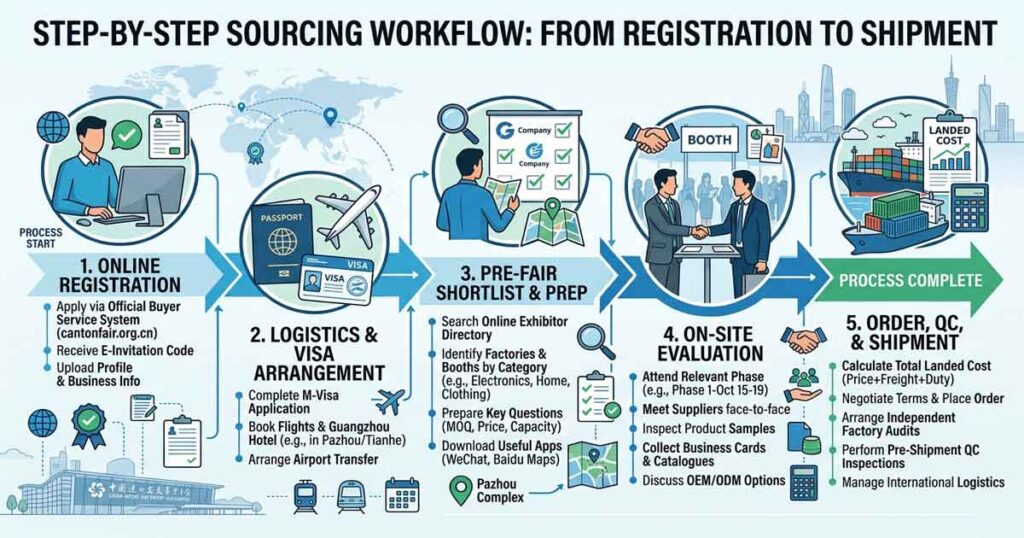
Who Should Attend the Canton Fair?
The exhibition can benefit businesses at different stages of development.
Small and medium-sized businesses can explore new products and compare manufacturers before committing to larger orders. Smaller buyers should ask about minimum order quantities, sample costs, and whether suppliers accept trial orders.
Importers and wholesalers can investigate production capacity, negotiate wholesale pricing, and develop relationships with multiple manufacturers. They should also evaluate lead times, export documentation, and shipping arrangements.
E-commerce sellers can discover products for online marketplaces and independent stores. Private-label options may help them differentiate their product ranges.
Retail chains and distributors can evaluate product collections, discuss distribution arrangements, and plan seasonal purchasing.
Sourcing agents and procurement professionals can compare suppliers on behalf of clients. Their priorities often include quality consistency, factory capacity, compliance, and production reliability.
For first-time visitors, the most important step is defining the purchasing objective before booking a trip. A focused sourcing plan usually delivers more value than walking through exhibition halls without a clear direction.
2. Canton Fair 2026 Dates and Schedule
Operating on a biannual basis, the massive trade exhibition alternates between spring and autumn sessions, with each split into three distinct product-focused phases.
Having an accurate expo calendar is critical when coordinating flights, securing accommodations, booking supplier meetings, and arranging factory site visits. Because event dates and arrangement details are subject to change between editions, always cross-reference the official schedule before purchasing non-refundable travel tickets.
Autumn Canton Fair 2026 Dates
According to the official Canton Fair website, the 140th session is scheduled as follows:
| Phase | Dates | Main theme |
|---|---|---|
| Phase 1 | October 15–19, 2026 | Advanced Manufacturing |
| Phase 2 | October 23–27, 2026 | Quality Home Life |
| Phase 3 | October 31–November 4, 2026 | Better Life |
Source: Official Canton Fair website.
The phases have separate date ranges, with breaks between them. Buyers interested in several product groups should account for these gaps when planning their itineraries.
For example, an importer sourcing electronics and household decorations may need to attend Phases 1 and 2. A retailer sourcing clothing and personal care products may prioritize Phase 3.
The right schedule depends on the products you intend to purchase, not simply on the earliest available flight.
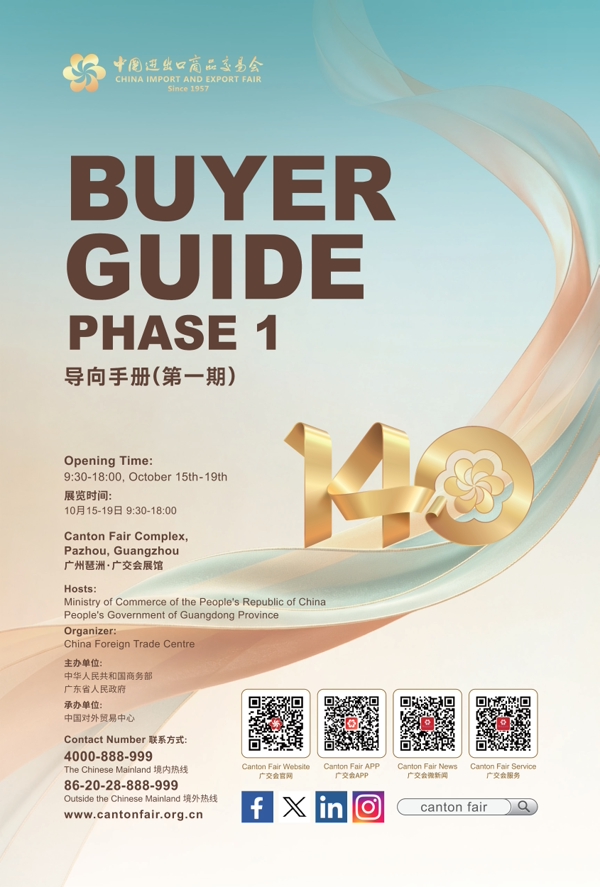
📌 Official Resource: Before heading to Guangzhou, make sure to grab the official documentation. You can view and download the latest The 140th Canton Fair Phase 1 Buyer Guide (PDF) directly from theCanton Fair Official Website.
Spring Canton Fair 2026 Dates
For historical planning and reference, the 139th Canton Fair’s spring session took place earlier in 2026. Before publishing or relying on a specific spring schedule, consult the official session archive.
If you are planning for the next spring edition, do not assume that dates or exhibition arrangements will remain identical. Confirm the announced calendar through the official website.
How Long Should You Attend?
The ideal visit depends on your sourcing objectives and the number of product categories you need to evaluate.
A focused buyer may need two or three days for one category. A company comparing numerous suppliers may require the full phase.
Allow additional time for follow-up meetings, product demonstrations, and factory visits. Avoid scheduling every hour, because promising supplier conversations often require more time than expected.
If your target categories appear in different phases, calculate the full travel cost before deciding to attend both. Flights, hotels, transfers, and lost working days can substantially increase the total budget.

3. Canton Fair Phases Explained: Products and Categories
Choosing the correct phase is one of the most important sourcing decisions. Each phase emphasizes different industries, although some product categories may overlap.
The official exhibition directory lists 13 major categories and 54 exhibition sections. Buyers can search exhibitors and products through the official Canton Fair website.
Phase 1: Electronics, Machinery, and Industrial Products
Dates: October 15–19, 2026.
Phase 1 focuses on advanced manufacturing and industrial technology. It suits buyers sourcing equipment, electronics, electrical products, tools, and related components.
Relevant categories include:
- Consumer electronics and household appliances.
- Industrial machinery and manufacturing equipment.
- Vehicles, motorcycles, and related products.
- Lighting and electrical equipment.
- Hardware and tools.
- Automation-related and innovative manufacturing products.
This phase is especially relevant to importers seeking electronics distributors, industrial suppliers, and manufacturers serving technical markets.
Before approaching suppliers, prepare a specification sheet. Include technical requirements, target pricing, certifications, packaging, and expected order quantities.
For machinery, request information about installation, spare parts, maintenance, and warranty coverage. For electronics, confirm applicable safety standards and testing requirements in your destination market.
Phase 2: Home Goods, Gifts, and Furniture
Dates: October 23–27, 2026.
Phase 2 concentrates on household products, decorative items, gifts, building materials, and furniture.
Typical sourcing interests include:
- Kitchenware and household accessories.
- Home decorations and seasonal gifts.
- Furniture and interior products.
- Building materials and bathroom equipment.
- Ceramics, glassware, and decorative objects.
- Selected consumer products for retail and wholesale distribution.
This phase can benefit retailers, homeware brands, furniture distributors, and online sellers.
Pay particular attention to materials, dimensions, packaging, and shipping volume. Bulky products can have attractive factory prices but expensive transportation costs.
For fragile goods, ask suppliers about export packaging and breakage rates. Request photographs of packaging tests when available.
Phase 3: Fashion, Textiles, Health, and Lifestyle Products
Dates: October 31–November 4, 2026.
Phase 3 emphasizes consumer-oriented products associated with everyday life, personal needs, and leisure.
Relevant categories include:
- Clothing, fashion accessories, and textiles.
- Home textiles and related products.
- Toys and baby products.
- Healthcare and personal care products.
- Sports, travel, and recreational goods.
- Stationery and other lifestyle products.
This phase is particularly useful for retailers and e-commerce businesses seeking new product lines.
Buyers should verify labeling, product safety, material composition, and destination-market requirements. Requirements vary significantly between toys, textiles, cosmetics, and healthcare products.
For seasonal merchandise, confirm production deadlines and shipping lead times. A product arriving after its selling season may create substantial losses.
Which Canton Fair Phase Should You Choose?
Use the following table to narrow your options.
| Your sourcing objective | Recommended phase |
|---|---|
| Electronics and appliances | Phase 1 |
| Machinery and industrial equipment | Phase 1 |
| Hardware and electrical products | Phase 1 |
| Homeware and kitchen accessories | Phase 2 |
| Furniture and decorative products | Phase 2 |
| Gifts and seasonal decorations | Phase 2 |
| Clothing and fashion accessories | Phase 3 |
| Textiles and home textiles | Phase 3 |
| Toys and baby products | Phase 3 |
| Sports and travel accessories | Phase 3 |
This table provides a starting point, not a substitute for the official product directory. Always check the current category listing before booking your visit.
4. How to Register for the Canton Fair
International buyers should arrange registration before traveling to Guangzhou. Advance preparation helps reduce delays and makes it easier to organize meetings.
Start with the official Canton Fair Buyer Service System. The platform provides registration services for overseas buyers and related invitation procedures.
Step 1: Create or Access Your Buyer Account
Open the official Buyer Service System and select the appropriate registration option. Returning visitors should check whether their existing account remains valid.
Follow the current instructions and enter your personal details accurately. Your registration information should match your identity documents.
Step 2: Complete Overseas Buyer Pre-Registration
Provide the requested information about your identity and business. Depending on your status, the system may request company details, sourcing interests, or supporting documents.
Check every field before submitting the application. Incorrect passport details can complicate badge collection or verification.
Step 3: Apply for a Buyer Badge
The buyer badge is the principal credential used for onsite access. The official badge guidance explains the documents accepted for different visitor categories.
A valid badge from a previous session may remain usable under current rules. However, do not assume that every historical badge or registration category remains valid.
Read the official 2026 buyer badge guidance before departure.
Step 4: Request an Invitation Letter if Needed
Some visitors need a Canton Fair invitation letter for travel or visa procedures. The official platform provides an invitation application process.
According to the organizer’s guidance, new overseas buyers generally register first, apply for a buyer badge, and then request an invitation.
Existing overseas buyers follow a process based on their current account and visitor status. Review the official invitation application guide.
An invitation letter does not guarantee visa approval. The relevant Chinese embassy or visa application center determines the applicable requirements.
Step 5: Confirm Badge Collection Arrangements
Check where and when your badge can be collected. Bring the original identification document specified by the official guidance.
Keep digital copies of your registration confirmation and travel documents. Store your passport securely while attending the exhibition.
Is Canton Fair Registration Free?
The answer depends on the particular service and circumstances. The official 2026 badge guidance states that new badge applications, replacements, and renewals are free of charge.
However, visitors should verify the latest instructions for their specific registration category. Travel, accommodation, translation, and other optional services may involve separate costs.
Be cautious of unofficial websites charging unnecessary fees for registration. Use the organizer’s official website for buyer registration and badge information.
5. Visa Requirements for International Buyers
Visa requirements depend on nationality, passport type, travel purpose, and current Chinese immigration rules.
Some travelers may qualify for visa-free entry under applicable arrangements. Others may need a business visa or another appropriate entry authorization.
Do not assume that attending a trade exhibition automatically exempts you from visa requirements.
Which Visa May Be Relevant?
Commercial visitors may need to consider China’s M visa, which covers qualifying commercial and trade activities.
The required documents can include a valid passport, an application form, a photograph, and business-related supporting documents. An invitation from a Chinese trade partner or exhibition may also be relevant.
Requirements differ by jurisdiction and can change. Consult the Chinese Visa Application Service Center or the Chinese embassy responsible for your place of residence.
For additional official information, consult the Ministry of Foreign Affairs of China.
How to Prepare Your Visa Application
- Check the current entry requirements for your nationality.
- Confirm whether you need a visa for the intended activities.
- Obtain the appropriate invitation or supporting business documents.
- Prepare your passport and application materials.
- Submit your application through the authorized channel.
- Wait for the official decision before finalizing non-refundable travel plans.
Visa-free entry, where available, may have conditions concerning permitted activities and length of stay. Confirm those conditions before traveling for business.
6. How to Find Reliable Suppliers at the Canton Fair
Finding a supplier is only the first step. The more important task is identifying a business capable of delivering the required quality, price, and production consistency.
The Canton Fair allows buyers to meet supplier representatives in person. However, a professional booth and attractive samples do not prove manufacturing capability.
Search the Official Exhibitor Directory
Start by searching the official exhibitor and product directory.
Use product names, technical specifications, and relevant categories. Record potential suppliers before arriving at the exhibition.
Create a shortlist with these details:
- Company name and booth number.
- Product categories and key specifications.
- Estimated minimum order quantity.
- Target price and currency.
- Customization options.
- Relevant certificates and test reports.
- Production capacity and estimated lead time.
- Contact details and follow-up status.
Important: Booth assignments can change between sessions. Confirm each supplier’s current location through the official directory or the latest exhibition floor plan.
Prepare Questions Before Meeting Suppliers
A structured conversation makes supplier comparisons easier. Ask the same core questions at each booth.
| Topic | Questions to Ask |
|---|---|
| Business identity | Are you a manufacturer, trading company, or both? |
| Product quality | What quality-control procedures do you use? |
| Minimum order | What is your MOQ for standard and customized products? |
| Pricing | Which price terms and quantities does your quotation cover? |
| Customization | Can you provide OEM, ODM, or private-label services? |
| Production | What is your current production lead time? |
| Compliance | Which product tests and certificates are available? |
| Packaging | Can you customize packaging for my destination market? |
| Payment | Which payment methods and milestones do you accept? |
| Shipping | Can you support export documentation and freight arrangements? |
Record the answers immediately after each meeting. Memory alone is unreliable when you meet dozens of suppliers.
How to Compare Quotes Fairly
A lower unit price does not always represent the best offer. Suppliers may quote different materials, packaging standards, quantities, or shipping terms.
Compare equivalent specifications before choosing a supplier. Request a written quotation with a clear validity period.
Check whether the price includes tooling, printing, packaging, testing, and other additional charges. Clarify the Incoterms rule and named location used in the quotation.
For example, an EXW quotation and an FOB quotation do not cover identical responsibilities or costs. Compare the full landed cost instead of focusing exclusively on factory pricing.
How to Verify a Chinese Supplier
Supplier verification should continue after the exhibition. Before paying a substantial deposit, collect evidence that supports the supplier’s identity and capabilities.
Recommended checks include:
- Obtain the company’s registered Chinese and English names.
- Request its business license and verify relevant registration details.
- Confirm the contracting entity and bank account beneficiary.
- Ask about factory ownership, production equipment, and subcontracting.
- Request recent production photographs or arrange a factory visit.
- Review relevant certificates and verify them with issuing bodies.
- Order samples and assess them against written specifications.
- Consider an independent factory audit or pre-shipment inspection.
A trading company is not necessarily an unsuitable supplier. Some trading companies provide useful sourcing, quality-control, and export services.
The key is understanding who will manufacture the goods and who accepts contractual responsibility. Make sure these details are documented.
7. Product Sourcing from China: Costs, MOQ, Quality, and Shipping
Attending the premier Guangzhou trade show empowers international buyers to evaluate Chinese manufacturers, wholesale suppliers, export companies, and private-label factories face-to-face. Attendees gain direct access to product sourcing, OEM manufacturing, ODM solutions, bulk purchasing, factory-direct pricing, custom packaging, sample ordering, and comprehensive export services.
Nevertheless, securing a profitable deal requires looking far beyond the initial unit quote. Profitability is fundamentally shaped by minimum order quantities, production capacity, product compliance, lead times, payment terms, freight expenses, customs tariffs, and overall supplier reliability. For emerging enterprises, partnering with a flexible manufacturer offering a manageable MOQ often outweighs working with massive factories boasting rock-bottom prices. Conversely, established importers prioritize production consistency, repeat-order scalability, and strict quality control protocols. Always benchmark wholesale proposals against your target landed cost prior to finalizing any purchase agreement.
What Does MOQ Mean?
MOQ stands for minimum order quantity. It is the smallest order a supplier is normally willing to accept under specified conditions.
Manufacturers may set different MOQs for standard products, customized designs, colors, and packaging. Custom molds or printed packaging can require larger commitments.
Ask whether a supplier offers a smaller trial order. A successful sample order can help establish confidence before larger purchases.
How Much Does It Cost to Buy from the Canton Fair?
There is no single standard purchasing cost. Your total budget depends on product specifications, quantity, travel expenses, shipping, and import requirements.
Consider these cost categories:
- Exhibition-related expenses and travel.
- Hotel accommodation and local transportation.
- Product samples and courier charges.
- Manufacturing and customization costs.
- Inspection, testing, and certification.
- International freight and insurance.
- Customs duties, taxes, and brokerage.
- Warehousing and domestic delivery.
The exhibition may provide access to competitive offers, but it does not guarantee lower prices. Request comparable quotations and calculate the full cost of bringing goods to your destination.
How to Calculate Landed Cost
Landed cost represents the total cost of obtaining products at the intended destination. The exact calculation depends on the transaction structure and applicable import rules.
A practical model is:
Landed cost per unit = Total product, logistics, insurance, import, inspection, and other applicable costs ÷ Sellable units received.
For example, a low-priced product may become unprofitable when freight, duties, defects, and marketplace fees are included.
Build a spreadsheet before approving an order. Test different quantities and shipping options to understand how costs change.
Should You Order Samples Before Bulk Production?
In most cases, yes. Samples help confirm appearance, dimensions, materials, functionality, and packaging.
For customized products, approve a reference sample before mass production. Record the approved specifications and acceptable quality limits in writing.
For higher-risk or regulated goods, consider independent testing. The required tests depend on the product and destination market.
How to Manage Product Quality
Quality requirements should be agreed before production begins. Avoid relying on verbal promises or vague descriptions such as “premium quality.”
Specify measurable requirements where possible. These may include dimensions, materials, color tolerances, performance standards, labeling, packaging, and defect limits.
For significant orders, consider inspections at different production stages. A pre-shipment inspection can identify problems before the goods leave the factory.
Inspection does not eliminate every risk, but it provides additional evidence for purchasing decisions.
8. How to Plan Your Canton Fair Visit
A productive visit starts before you arrive in Guangzhou. Build your itinerary around product categories, shortlisted suppliers, and scheduled meetings.
Create a Supplier Shortlist
Review the official exhibitor directory before the exhibition opens. Identify the companies that best match your purchasing requirements.
Group suppliers by category and booth location. Prioritize the most relevant meetings instead of trying to visit every stand.
Prepare a short company introduction. Explain your market, product requirements, expected quantities, and purchasing timeline.
Prepare a Sourcing Checklist
Bring the following items:
- Passport and required buyer registration documents.
- Business cards and company contact information.
- Product specifications and reference photographs.
- Target prices and estimated order quantities.
- A notebook or digital supplier comparison sheet.
- Questions about compliance, packaging, and delivery.
- Sample evaluation criteria.
- A portable charger and essential travel items.
Comfortable shoes are useful because exhibition halls cover substantial areas. Allow time for queues, navigation, meals, and unexpected meetings.
Plan Your Daily Route
The exhibition complex is located at No. 382 Yuejiang Zhong Road, Haizhu District, Guangzhou.
The venue’s official information identifies Metro Line 8 stations serving different exhibition areas. Xingangdong and Pazhou stations provide access to the complex.
Check the latest official Canton Fair travel information before traveling. Follow the current venue map because entrances and routes depend on your destination hall.
Schedule your highest-priority supplier meetings early in the day. Leave time for promising conversations and additional product discoveries.
Keep Accurate Supplier Records
After each meeting, record the supplier’s name, booth, products, quotation, MOQ, and next steps.
Take product photographs only when the exhibitor permits them. Label each photograph so you can match it with the correct supplier later.
Request written quotations and contact details. A brief follow-up message after the meeting helps maintain momentum.
9. Canton Fair Travel Guide: Hotels, Transport, and Practical Advice
Guangzhou is a major commercial city with extensive transport and accommodation options. During the Canton Fair, demand around the exhibition complex can increase significantly.
Where Should You Stay?
Choose accommodation based on your exhibition schedule, budget, and transport preferences.
Hotels near Pazhou can reduce commuting time. However, they may be expensive or book up quickly during major sessions.
Accommodation farther away may offer better value, especially near convenient metro stations. Compare the total journey rather than hotel distance alone.
Book early and confirm cancellation conditions. Allow flexibility if your supplier meetings or travel arrangements change.
How Can You Reach the Exhibition Complex?
Many visitors use Guangzhou Metro, taxis, or prearranged transfers.
Metro Line 8 serves the exhibition area, including Xingangdong and Pazhou stations. The appropriate station depends on the hall and entrance you need.
If you arrive by air, plan the airport transfer in advance. Travel time varies with traffic, route, and transport method.
Use the official venue map to identify your destination. Do not rely solely on a supplier’s description of its booth location.
Payments, Connectivity, and Communication
Prepare a reliable way to access maps, email, translation tools, and business contacts. Check international roaming, local connectivity, and payment arrangements before departure.
Payment options and access to international services may differ from those in your home country. Confirm the practical arrangements that suit your devices and accounts.
Keep copies of important documents in a secure location. Share your itinerary with a colleague when appropriate.
Should You Hire a Sourcing Agent?
A sourcing agent may help with supplier communication, factory visits, product inspections, negotiations, and logistics coordination.
This can be useful when you lack Chinese-language skills or cannot remain in China for extended periods. However, agent quality and service scope vary.
Before engaging an agent, clarify fees, deliverables, supplier disclosure, and potential conflicts of interest. Ask how the agent verifies factories and reports inspection findings.
Confirm who signs the purchase contract and who receives payments. Transparent responsibilities reduce misunderstandings.
10. Canton Fair vs. Alibaba: Which Is Better?
The Canton Fair and Alibaba support different sourcing workflows. Neither is automatically better for every buyer.
The Canton Fair emphasizes in-person meetings and physical product inspection. Alibaba supports online supplier discovery and communication from almost anywhere.
| Factor | Canton Fair | Alibaba |
|---|---|---|
| Supplier discovery | In-person and online tools | Primarily online |
| Product inspection | Physical samples at booths | Samples must usually be ordered |
| Travel required | For onsite participation | Not usually |
| Supplier meetings | Face-to-face opportunities | Remote communication |
| Time investment | Travel and exhibition attendance | Online research and follow-up |
| Supplier comparison | Direct product comparisons | Digital listings and quotations |
| Best use | Relationship building and focused sourcing trips | Remote research and ongoing supplier searches |
When Is the Canton Fair the Better Choice?
An onsite visit may be worthwhile when you need to inspect products, compare multiple manufacturers, or discuss complex customization.
It can also help when personal meetings are important to your purchasing process. However, the trip requires time and money.
When Is Online Sourcing More Practical?
Online sourcing can be more convenient for small test orders or preliminary supplier research. It allows buyers to contact companies without traveling to China.
However, online listings should not replace independent supplier verification. Request samples, check documentation, and agree on written specifications.
Can You Use Both Methods?
Yes. A combined approach can make sourcing more efficient.
Use online directories to build an initial shortlist. Visit the Canton Fair to inspect selected products and meet promising suppliers.
After the exhibition, compare written quotations and complete due diligence. You can also contact shortlisted suppliers remotely if travel is not feasible.
11. Common Canton Fair Mistakes to Avoid
Even experienced buyers can make costly sourcing mistakes. A structured process helps reduce avoidable risks.
Mistake 1: Visiting without a product plan. Prepare target categories, specifications, and a shortlist before arriving.
Mistake 2: Choosing only by price. Compare quality, compliance, packaging, lead times, and total landed cost.
Mistake 3: Assuming every exhibitor is a factory. Ask about manufacturing facilities, subcontractors, and contractual responsibilities.
Mistake 4: Ignoring destination-market regulations. Verify applicable product safety, labeling, and import requirements before ordering.
Mistake 5: Paying before verifying the supplier. Confirm the contracting entity and payment beneficiary. Use a suitable written agreement.
Mistake 6: Failing to approve samples. Establish the expected product quality before mass production.
Mistake 7: Forgetting post-exhibition follow-up. Organize quotations, samples, and next steps immediately after the event.
Mistake 8: Underestimating logistics costs. Calculate freight, insurance, duties, taxes, and final delivery before approving the order.
The best results come from treating the exhibition as the beginning of a sourcing process, not the end.
12. Is the Canton Fair Worth Visiting?
For many international buyers, the Canton Fair can be a valuable investment. Its usefulness depends on your sourcing objectives, preparation, purchasing volume, and travel budget.
The exhibition is particularly attractive when you need to compare several suppliers in one trip. It can also help you discover new products and evaluate customization opportunities.
However, attending does not guarantee better prices, reliable suppliers, or successful orders. Those outcomes depend on due diligence, negotiation, and quality management.
Who Benefits Most from Attending?
The Canton Fair is especially useful for businesses that:
- Plan to source multiple products from China.
- Need to compare manufacturers and product specifications.
- Want to develop private-label or customized products.
- Expect to place repeat orders with Chinese suppliers.
- Need direct communication with supplier representatives.
- Have sufficient purchasing potential to justify travel expenses.
Smaller businesses can benefit too. They should focus on a limited number of product categories and confirm supplier MOQs beforehand.
What Are the Main Disadvantages?
International travel requires a budget and advance planning. The exhibition is also large, so finding the right suppliers takes preparation.
Some exhibitors may not match your purchasing requirements. Others may offer products that require additional certification or customization.
Therefore, calculate your expected return before attending. Consider the value of potential supplier relationships, not just immediate savings on individual products.
13. Frequently Asked Questions About the Canton Fair
What Is the Canton Fair Famous For?
The Canton Fair is known for connecting international buyers with Chinese manufacturers, suppliers, and exporters. It covers electronics, machinery, household goods, furniture, fashion, textiles, toys, and other product categories. Buyers use the exhibition to compare products, discuss customization, and develop business relationships.
Where Is the Canton Fair Held?
The Canton Fair takes place at the China Import and Export Fair Complex in Guangzhou, Guangdong Province, China. The venue address is No. 382 Yuejiang Zhong Road, Haizhu District, Guangzhou. Use the official venue map to locate the relevant exhibition hall.
Can Anyone Attend the Canton Fair?
The exhibition primarily serves business buyers and trade professionals. Overseas visitors must follow the organizer’s registration and identification requirements. Check the current buyer registration guidance before planning your visit.
Is the Canton Fair Free to Visit?
The official 2026 guidance states that new buyer badge applications, replacements, and renewals are free. However, visitors should verify the requirements for their registration category. Flights, accommodation, transport, and other optional services involve separate expenses.
Do I Need a Visa to Attend the Canton Fair?
Visa requirements depend on your nationality, travel purpose, and current Chinese entry rules. Some travelers may qualify for visa-free entry, while others need an appropriate visa. Check the relevant Chinese embassy or authorized visa application center before traveling.
How Do I Get an Invitation Letter for the Canton Fair?
Start by registering or logging into the official Buyer Service System. Follow the applicable process for your visitor status and buyer badge. The organizer provides an official invitation application guide. An invitation letter does not guarantee visa approval.
Which Canton Fair Phase Is Best for Electronics?
Phase 1 is generally the best starting point for electronics, household appliances, machinery, lighting, electrical products, and hardware. Check the official product directory for your specific category. Exhibition sections and arrangements should be verified for the relevant session.
Which Canton Fair Phase Is Best for Clothing?
Phase 3 is the recommended starting point for clothing, fashion accessories, textiles, and many lifestyle products. Buyers should confirm the current category directory before booking travel. Related products may appear in other sections.
How Do I Find a Manufacturer at the Canton Fair?
Search the official exhibitor directory before attending. Shortlist suppliers by product category, specifications, and business requirements. At the exhibition, ask about factory ownership, production capacity, MOQ, and quality control. Verify the supplier independently before placing an order.
Can Small Businesses Buy from Canton Fair Suppliers?
Yes, small businesses can explore suppliers and discuss potential orders. However, manufacturers often have minimum order quantities and different terms for customized products. Ask about trial orders, sample costs, and standard-product options before committing.
Can I Buy Products Directly at the Canton Fair?
The exhibition primarily facilitates business-to-business sourcing and negotiations. Samples may be available for inspection, but immediate retail purchases are not guaranteed. Buyers should agree on ordering, payment, production, and delivery arrangements directly with the supplier.
How Many Days Should I Spend at the Canton Fair?
A focused visit may require two or three days within one phase. Buyers evaluating many suppliers may need longer. If your target products appear in different phases, consider the additional accommodation and travel costs.
Is the Canton Fair Better Than Alibaba?
The two options serve different purposes. The Canton Fair enables face-to-face meetings and direct product inspection, while Alibaba supports remote supplier discovery. Many buyers combine online research with in-person meetings to improve their sourcing decisions.
How Can I Avoid Scams When Sourcing from China?
Verify the supplier’s registered identity, contractual entity, and payment beneficiary. Request samples, written specifications, and relevant certificates. Consider factory audits and independent inspections for substantial orders. Never rely solely on a booth, website, or attractive quotation.
Conclusion: Make the Canton Fair Part of Your Sourcing Strategy
The Canton Fair offers international buyers a practical way to explore Chinese products, compare suppliers, and develop business relationships. Its three-phase structure helps buyers focus on relevant product categories.
However, successful sourcing requires more than attending the exhibition. Buyers should prepare specifications, compare written quotations, verify suppliers, and calculate landed costs.
Before traveling, confirm the latest schedule, registration requirements, and visa rules. During the exhibition, record supplier details and agree on clear follow-up actions.
After returning home, evaluate samples, verify documentation, and arrange quality inspections where appropriate. This structured approach can help turn exhibition contacts into reliable long-term supply relationships.
For businesses sourcing from China, the best results come from combining direct supplier engagement with careful verification and disciplined purchasing decisions.