
What is the Main Product of China? A 2026 Global Trade Analysis
What is the Main Product of China?
China has transformed from the “world’s factory” into a high-tech industrial superpower. For decades, global consumers associated Chinese exports with low-cost textiles and mass-market goods. However, by 2026, the answer to the question “What is the main product of China?” is far more sophisticated.
Today, China’s dominant export sector is Machinery and Electrical Equipment, including:
- Smartphones
- Computers and semiconductors
- Industrial machinery
- Electric vehicles (EVs)
- Lithium-ion batteries
- Telecommunications equipment
- Consumer electronics
According to recent trade data, machinery and electrical products account for approximately 60–61% of China’s total exports, generating more than $2.3 trillion USD annually. China’s manufacturing ecosystem now drives global supply chains in electronics, green energy, robotics, and advanced industrial production.
China’s export leadership is supported by major industrial cities such as Shenzhen, Suzhou, Dongguan, Shanghai, Guangzhou, and Ningbo, which together form one of the largest manufacturing networks in the world.
Why Machinery and Electronics Are the Main Product of China
The biggest reason machinery and electronics dominate Chinese exports is the country’s unmatched industrial infrastructure. China combines:
- Massive production capacity
- Integrated supply chains
- Advanced logistics systems
- Competitive labor costs
- Government-backed industrial policy
- High automation levels
The result is a vertically integrated manufacturing ecosystem capable of producing everything from microchips to industrial robots.
By 2026, China remains the largest exporter of:
- Smartphones
- Consumer electronics
- Solar panels
- Lithium batteries
- Electric vehicles
- Industrial equipment
- Telecommunications hardware
The country also dominates upstream production of many critical materials, including rare earth elements, battery components, and electronic assemblies.
What is the Main Product of China in 2026? Key Export Categories
The structure of Chinese exports has shifted significantly over the past decade. Traditional labor-intensive products such as apparel and toys are gradually declining in relative importance, while high-value technological goods continue expanding.
China’s Top Export Categories in 2026
| Export Category | Estimated Export Value | Share of Total Exports | Growth Trend |
|---|---|---|---|
| Machinery & Electronics | ~$2.3 Trillion | 60–61% | Strong Growth |
| Electric Vehicles (EVs) | ~$150+ Billion | Rapidly Expanding | Very Strong |
| Lithium-Ion Batteries | Part of “New Three” industries | High Growth | +20%+ |
| Textiles & Apparel | ~$300 Billion | Declining Share | Weak |
| Solar Panels & Green Tech | Growing Rapidly | Strategic Sector | Strong |
| Industrial Robots & Automation Equipment | Fast Expanding | High-Tech Priority | Strong |
China’s export transition reflects its broader economic strategy known as industrial upgrading, which focuses on advanced manufacturing, automation, artificial intelligence, and green technologies.
Infographic: China’s Export Structure in 2026
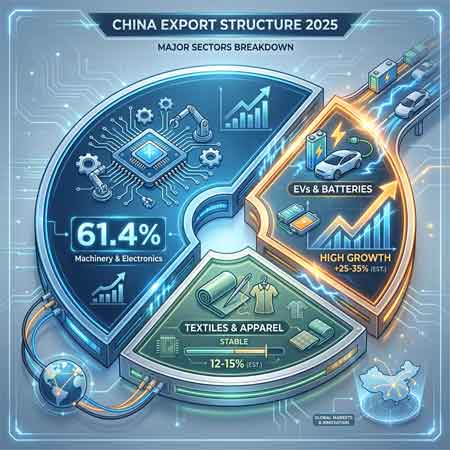
+---------------------------------------------------+
|              CHINA EXPORT STRUCTURE 2026          |
+---------------------------------------------------+
| Machinery & Electronics          | 61%            |
| Electric Vehicles & Batteries    | 12%            |
| Chemicals & Industrial Materials | 10%            |
| Textiles & Apparel               | 8%             |
| Furniture & Consumer Goods       | 5%             |
| Other Products                   | 4%             |
+---------------------------------------------------+
| Key Manufacturing Hubs:                          |
| Shenzhen | Suzhou | Dongguan | Shanghai | Ningbo |
+---------------------------------------------------+
How China Became the World’s Manufacturing Leader
China’s manufacturing rise did not happen overnight. After economic reforms in the late 20th century, the country invested heavily in:
- Export-oriented industrial zones
- Port infrastructure
- Logistics corridors
- Special Economic Zones (SEZs)
- Foreign direct investment (FDI)
- Technology transfer partnerships
Cities like Shenzhen evolved from small fishing towns into global innovation centers. Today, Shenzhen is often called the “Silicon Valley of Hardware.”
Meanwhile, regions such as the Yangtze River Delta and the Pearl River Delta became the backbone of China’s export machine.
These industrial clusters dramatically reduced production costs while improving manufacturing efficiency.
What is the Main Product of China Compared to the Past?
Twenty years ago, China’s exports were dominated by:
- Clothing
- Footwear
- Toys
- Furniture
- Plastic consumer goods
In 2026, the export profile is fundamentally different.
China now exports:
- AI-enabled electronics
- Smart devices
- Industrial robotics
- Renewable energy systems
- EV batteries
- Semiconductor-related products
- Advanced machinery
This transition demonstrates China’s movement up the global value chain.
The country’s “Made in China 2025” strategy accelerated investment in high-tech sectors including:
- Robotics
- Aerospace
- Biotechnology
- Electric mobility
- Telecommunications
- Artificial intelligence
As a result, China is no longer merely a low-cost manufacturing hub — it is increasingly competing in advanced industrial innovation.
The Role of Electric Vehicles in China’s Export Growth
One of the fastest-growing answers to “What is the main product of China?” is now electric vehicles.
China became the world’s largest EV exporter thanks to companies such as:
- BYD
- Geely
- SAIC Motor
- NIO
- XPeng
Chinese EV exports surged due to:
- Competitive pricing
- Strong battery supply chains
- Government subsidies
- Advanced battery manufacturing
- Growing demand in Europe, Southeast Asia, and Latin America
The country also dominates lithium-ion battery production through companies like CATL and BYD, giving China strategic control over critical segments of the green energy economy.
By 2026, EVs, batteries, and solar technologies are collectively known as China’s “New Three” export industries, replacing older labor-intensive sectors.
What is the Main Product of China for Global Supply Chains?
China remains essential to global supply chains because many international industries depend on Chinese components and intermediate goods.
Examples include:
- Smartphone assemblies
- Circuit boards
- Industrial motors
- Battery cells
- Consumer electronics components
- Solar panel modules
- Rare earth processing
Even companies that diversify manufacturing into Vietnam, India, or Mexico often continue relying on Chinese suppliers for critical parts.
China’s export ecosystem benefits from:
- High manufacturing density
- Efficient ports
- Advanced shipping infrastructure
- Extensive supplier networks
- Strong economies of scale
This supply chain integration is extremely difficult for competitors to replicate quickly.
Major Chinese Manufacturing Cities Driving Exports
Shenzhen
The global center for electronics manufacturing, semiconductors, telecommunications equipment, and consumer technology.
Suzhou
A major hub for precision manufacturing, semiconductors, and industrial automation.
Dongguan
Known for electronics assembly, hardware manufacturing, and export-oriented factories.
Shanghai
China’s financial and industrial powerhouse with advanced automotive and technology manufacturing.
Ningbo
One of the world’s busiest ports and a critical export logistics center.
Guangzhou
A leading manufacturing base for automobiles, consumer products, and industrial equipment.
These cities collectively support China’s dominance in international trade.
Challenges Facing China’s Export Economy in 2026
Despite its strengths, China faces several major export challenges:
Rising Trade Tensions
Tariffs and geopolitical disputes with the United States and Europe continue affecting technology exports.
Supply Chain Diversification
Many multinational companies are adopting “China Plus One” strategies by expanding manufacturing into Southeast Asia and India.
Demographic Pressures
China’s aging population may gradually reduce labor force growth.
Semiconductor Restrictions
Advanced chip restrictions remain a strategic challenge for China’s technology sector.
However, China continues investing heavily in automation, robotics, AI manufacturing, and domestic semiconductor development.
Future Outlook: What is the Main Product of China Likely to Be?
Over the next decade, China’s exports will likely become even more technology-focused.
Key growth sectors include:
- Artificial intelligence hardware
- Industrial robotics
- Renewable energy systems
- Electric vehicles
- Advanced batteries
- Smart manufacturing equipment
- Green energy technologies
China’s long-term strategy focuses on transitioning from “Made in China” to “Created in China,” emphasizing innovation, intellectual property, and high-value industrial production.
Even as labor-intensive manufacturing moves to lower-cost countries, China is expected to remain the world’s largest exporter of advanced industrial goods.
Conclusion
So, what is the main product of China in 2026?
The clear answer is Machinery and Electrical Equipment, including electronics, industrial machinery, EVs, batteries, and advanced technological products.
China’s export economy has evolved dramatically from low-cost textiles toward high-tech manufacturing leadership. Backed by enormous industrial capacity, advanced logistics infrastructure, and aggressive investment in innovation, China remains the central hub of global manufacturing.
While geopolitical tensions and supply chain diversification create new challenges, China continues strengthening its position in electric vehicles, batteries, robotics, and green technology.
For businesses, investors, and global supply chain professionals, understanding China’s export structure is essential for navigating the future of international trade.
FAQ
What is the main product of China?
China’s main export products are machinery and electrical equipment, including electronics, industrial machinery, computers, smartphones, and electric vehicles.
What percentage of China’s exports are electronics and machinery?
Machinery and electrical products account for roughly 60–61% of China’s total exports.
Which city is the manufacturing center of China?
Shenzhen is widely considered China’s leading manufacturing and electronics hub.
Is China still the world’s factory?
Yes. Although manufacturing diversification is increasing globally, China remains the largest manufacturing economy and exporter in the world.
What are China’s fastest-growing export industries?
The fastest-growing sectors include electric vehicles, lithium-ion batteries, solar technology, robotics, and advanced electronics.
Why is China important to global supply chains?
China has highly integrated manufacturing ecosystems, efficient ports, massive supplier networks, and economies of scale that support global industries.